
.gif?width=2000&height=800&name=September%202026%20Econ%20Corner%20Title%20Graphics%20%20(1).gif "September 2026 Econ Corner Title Graphics (1)")
Key Takeaways
- Labor Market Avoids Downturn Despite Slow Hiring: U.S. employers added 29,000 jobs in September, while July and August payroll gains were revised downward by a combined 60,000 jobs. Hiring has cooled, but widespread layoffs have not emerged.
- Unemployment Higher But Labor Force Participation Stronger: The unemployment rate slightly increased (+0.1%) to 4.2%, but that rise coincided with a larger rate of increase (+0.2%) in the labor force.
- Positive Signs for Goods-Producing Industries: Construction, Manufacturing, and Trade, Transportation, and logistics-related industries outperformed their historical trends. Larger service-sector categories, including Professional and Business Services, Information, and Government saw some of the biggest declines.
Labor Market Overview
Key Employment Insights
- Payroll on the decline
October’s largest payroll gains were in the Manufacturing and Professional & Business Services sectors. Transportation and Information Technology sectors saw the biggest decline. - Federal job cuts hampered employment growth in Q1
The recent job cuts to the federal workforce has negatively impacted the country's overall employment growth in Q1. Based on recent data from the BLS, these cuts will continue to have a negative ripple affect throughout the rest of the year. - 100k jobs lost due to recent natural disasters
Nearly 100,000 individuals lost their jobs in Q1 due to the recent wildfires, hurricanes, and flash flood that have impacted most of the country.
Looking Ahead in Q2
- Tariffs will continue to impact labor market
Based on preliminary data from the BLS, the ongoing tariff war could result in the loss of nearly 100,000 jobs across the US in Q2 alone. As businesses continue to struggle with prices, we could expect an increase in layoffs to compensate for the higher overhead costs.
- New legislation is expected to boost US employment
New legislation proposed by the Trump administration to abolish taxes could result in a significant boost to the U.S. labor market, potentially adding one million jobs across the country. - Cutting interest rates could lead to recession
If the Federal Reserve fails to achieve a soft landing in the coming months, economists predict it might send the country into a recession and result in the loss of thousands of jobs.
- National Employment - Quarterly
- National Employment - Monthly
- National Unemployment - Quarterly
- National Unemployment - Monthly
- Labor Force Participation Rate
- U6 & U3 Unemployment Rates
NOTE: Data for October 2025 were not collected due to the federal government shutdown.
At a Glance
Employment
The Bureau of Labor Statistics (BLS) reported job growth of 29,000 jobs in September. The job gains in July and August were revised downward, returning July to a month with job loss. With these changes, the employment outlook appears better than it did two months ago but hopes of August’s job performance signifying an end to the cooling hiring environment are on hold after little growth in September. Real private-sector wages have moved little over the last three months.
Unemployment
The U-6 unemployment rate, which includes discouraged, underemployed, and unemployed workers in the country, fell to 7.6% in September. The U-3 unemployment rate, which indicates only the number of unemployed people actively seeking a job, ticked up to 4.2%. The labor force participation rate (LFPR) had been in steep decline since November 2025 but has improved for two consecutive months, currently standing at 61.8%. Even though the unemployment rate increased, the larger increase in the LFPR is a positive sign that the labor market is attracting new participants without displacing those already employed.
New Developments
September’s industry results were unusual because some of the more cyclical, goods-oriented portions of the economy held up better than many large service industries. Goods-producing employment increased by 18,000, including gains of 11,000 in Construction and 9,000 in Manufacturing. Those increases are meaningful because goods-producing industries account for a much smaller share of total employment than services. Manufacturing has now added 72,000 jobs since its recent low in December 2025, with September gains concentrated in Plastics and Rubber Products and Machinery Manufacturing. Distribution-related industries also remained comparatively resilient. Transportation and Warehousing added 7,600 jobs, Wholesale Trade gained 5,000, and Retail Trade increased by 5,800. By contrast, several service categories contracted, including Information (-10,000), Professional and Business Services (-9,000), and Financial Activities (-7,000), while Government employment fell by 17,000. This pattern does not necessarily indicate a broad industrial resurgence—the BLS characterized changes in all major industries as relatively small—but it suggests that September’s weakness was concentrated more heavily in office-based and government employment than in construction, manufacturing, and the industries responsible for moving and distributing goods.
The rise in unemployment from 4.1% to 4.2% is less concerning when viewed alongside the much stronger expansion of the labor force. The civilian labor force increased by 485,000 in September, while household employment rose by 406,000. Consequently, the number of unemployed people increased by only 78,000. The labor force participation rate climbed another 0.2 percentage point to 61.8%, following a similar increase in August, and the employment-to-population ratio edged higher to 59.2%. In this case, therefore, the increase in unemployment partly reflects more people entering or returning to the labor market rather than a substantial loss of employment. That distinction is important: an economy that can absorb most new labor-force entrants is in a stronger position than one in which unemployment rises because existing workers are losing jobs. There were also signs that available labor supply broadened beyond the headline participation measure. The number of people marginally attached to the labor force declined by 236,000 to 1.5 million. Nevertheless, longer-term unemployment remains an area of concern, with 1.9 million people unemployed for at least 27 weeks, accounting for 27.3% of all unemployed workers.
A Deeper Look
September creates a more complicated decision for the Federal Reserve following its September 16 increase in the federal funds target range to 3.75%–4.00%. The Fed justified that move in part by stating that inflation remained elevated, and its September projections showed a median 2026 PCE (Personal Consumption Expenditures) inflation forecast of 3.7%, still well above the Committee’s 2% longer-run objective. The employment report, however, provides less evidence that additional restraint is immediately necessary from the labor-market side. Payrolls increased by only 29,000, July and August employment was revised downward by a combined 60,000, and nominal average hourly earnings rose just 0.1% during September and 3.0% over the past year. These figures point toward moderating labor demand and wage pressure. At the same time, the increase in participation and household employment argues against interpreting September as a sudden deterioration in labor conditions. The report therefore gives policymakers reasons to be cautious in either direction. The Federal Reserve’s September projections had already indicated considerable support for maintaining restrictive policy through year-end. Incoming inflation data, rather than the unemployment rate alone, will play a much more important role in determining whether policymakers see another rate increase as warranted at the October 27–28 or December 8–9 meetings.
September’s payroll report reveals much beyond the total employment estimate. July employment was revised from a gain of 21,000 to a loss of 10,000, while August was reduced from 162,000 to 133,000, subtracting 60,000 jobs from the previously reported two-month total. September’s 29,000 increase also fell below the average monthly gain of 45,000 over the preceding year, confirming that hiring has slowed substantially even though outright job losses remain limited. Wage and hours data similarly point toward slower labor demand: nominal average hourly earnings increased 3.0% from a year earlier, while the average private-sector workweek held at 34.4 hours. Combined with rising labor-force participation, September depicts a labor market that is becoming less tight without yet showing the broad layoffs normally associated with a pronounced downturn. Whether firms continue absorbing additional workers will be an important test of labor-market resilience during the final quarter of 2026.
Employment FAQs
How have the federal job cuts impacted the labor market?
We will begin in this chapter by dealing with some general quantum mechanical ideas. Some of the statements will be quite precise, others only partially precise. It will be hard to tell you as we go along which is which, but by the time you have finished the rest of the book, you will understand in looking back which parts hold up and which parts were only explained roughly.
What are the implications of the tariff war from a labor perspective?
We will begin in this chapter by dealing with some general quantum mechanical ideas. Some of the statements will be quite precise, others only partially precise. It will be hard to tell you as we go along which is which, but by the time you have finished the rest of the book, you will understand in looking back which parts hold up and which parts were only explained roughly.
Will getting rid of taxes really jump start the labor market?
We will begin in this chapter by dealing with some general quantum mechanical ideas. Some of the statements will be quite precise, others only partially precise. It will be hard to tell you as we go along which is which, but by the time you have finished the rest of the book, you will understand in looking back which parts hold up and which parts were only explained roughly.
How optimistic are economists about the labor market in the coming months?
We will begin in this chapter by dealing with some general quantum mechanical ideas. Some of the statements will be quite precise, others only partially precise. It will be hard to tell you as we go along which is which, but by the time you have finished the rest of the book, you will understand in looking back which parts hold up and which parts were only explained roughly.

Key Unemployment Insights
- Steady as it goes
Throughout Q1 2025, The unemployment rate has consistently remained low at 4%, indicating a stable job market, boosting economic growth and consumer confidence. - Shifting Job Vacancy Ratios
The ratio of vacant jobs to jobless workers has decreased, indicating a shift in the labor market's dynamics. While still relatively tight, the market is becoming less intensely competitive for workers than it was previously - Changes in Voluntary Quits
The rate of voluntary quits has decreased, suggesting that workers are becoming less inclined to leave their current jobs. This could indicate increased caution among workers due to economic uncertainty, or increased job satisfaction.
Looking Ahead In Q2
- Tariffs will continue to impact labor market
While currently low, we anticipate the unemployment rate will gradually increase in Q2. However, this increase is expected to remain within a relatively narrow and historically healthy range.
- Federal Reserve Actions
If the Fed maintains or increases interest rates to combat inflation, it could lead to a slowdown in economic growth and potentially higher unemployment. Conversely, if the Fed begins to lower rates, it could stimulate growth and keep unemployment lower. - The Rise of Contract and Temporary Work
An increase in contract and temporary hiring suggests that businesses may be adopting a more flexible approach to staffing, possibly due to economic uncertainty. This also shows that the "quality" of jobs, may be changing.
Breaking it down Further
Despite mounting economic and geopolitical uncertainty, the national labor market notched another month of decent job gains and low unemployment. But there’s also potential trouble brewing beneath the surface of this report. Inflation remains stubbornly high and may yet climb higher. A rapid reversal in federal government hiring is showing signs of trickling down into state and local government hiring. And it remains uncomfortably difficult for unemployed people who want a job to quickly find one.All eyes will likely be on federal employment, which officially fell by 10,000 in February. But the total reduction in federal employment was likely even larger last month, given the timing of data collection that happened towards the beginning of last month. Federal employment (minus post office workers) added an average of 6,400 jobs per month between July 2022 and March 2024, slowing to roughly 3,000/month towards the end of last year and then falling off a cliff last month. This federal slowdown is also showing signs of trickling down into state and local government hiring. Local government employment gains have fallen from an average of 36,000 jobs added per month between December 2023 and February 2024, to 18,000 in the past three months.
Going forward, the full impacts of all the new policies, proposals, and abrupt reversals that are the hallmarks of this administration will begin to shape the official statistics — good, bad, or indifferent. The market’s ability to maintain its “business as usual” momentum will be tested and the anticipated soft economic landing continues to hang in the balance.
Unemployment FAQs
How will the recent natural disasters affect the unemployment rate?
We will begin in this chapter by dealing with some general quantum mechanical ideas. Some of the statements will be quite precise, others only partially precise. It will be hard to tell you as we go along which is which, but by the time you have finished the rest of the book, you will understand in looking back which parts hold up and which parts were only explained roughly.
What is the current unemployment duration?
We will begin in this chapter by dealing with some general quantum mechanical ideas. Some of the statements will be quite precise, others only partially precise. It will be hard to tell you as we go along which is which, but by the time you have finished the rest of the book, you will understand in looking back which parts hold up and which parts were only explained roughly.
Will the federal job cuts impact people claiming unemployment benefits?
We will begin in this chapter by dealing with some general quantum mechanical ideas. Some of the statements will be quite precise, others only partially precise. It will be hard to tell you as we go along which is which, but by the time you have finished the rest of the book, you will understand in looking back which parts hold up and which parts were only explained roughly.
How optimistic are economists about the labor market in the coming months?
We will begin in this chapter by dealing with some general quantum mechanical ideas. Some of the statements will be quite precise, others only partially precise. It will be hard to tell you as we go along which is which, but by the time you have finished the rest of the book, you will understand in looking back which parts hold up and which parts were only explained roughly.
Employment
- In Brief: October’s largest payroll losses were in the Manufacturing and Professional & Business Services sectors. Professional & Business Services fully recovered its loss in November (+3,000 over the last two months), but Manufacturing will have a longer path to regaining its jobs (-26,000 over the same period).
- The Big Picture: Private Education & Health Services and the Public sectors in November maintained the high growth we have seen over the last year and look to remain the primary job generators in the labor market heading into next year.
- Diving in: Despite mounting economic and geopolitical uncertainty, the national labor market notched another month of decent job gains and low unemployment. But there’s also potential trouble brewing beneath the surface of this report. Inflation remains stubbornly high and may yet climb higher. A rapid reversal in federal government hiring is showing signs of trickling down into state and local government hiring. And it remains uncomfortably difficult for unemployed people who want a job to quickly find one.
All eyes will likely be on federal employment, which officially fell by 10,000 in February. But the total reduction in federal employment was likely even larger last month, given the timing of data collection that happened towards the beginning of last month. Federal employment (minus post office workers) added an average of 6,400 jobs per month between July 2022 and March 2024, slowing to roughly 3,000/month towards the end of last year and then falling off a cliff last month. This federal slowdown is also showing signs of trickling down into state and local government hiring. Local government employment gains have fallen from an average of 36,000 jobs added per month between December 2023 and February 2024, to 18,000 in the past three months.
Going forward, the full impacts of all the new policies, proposals, and abrupt reversals that are the hallmarks of this administration will begin to shape the official statistics — good, bad, or indifferent. The market’s ability to maintain its “business as usual” momentum will be tested and the anticipated soft economic landing continues to hang in the balance.
Unemployment
- In Brief:
- What Does This Mean?: An increasing unemployment rate (both U-3 & U-6) with a declining labor force participation rate is a worrying combination. It indicates that some who were previously looking for work have become discouraged and stopped, but even those who have remained in the labor force are finding it more difficult to be employed. This may be another symptom of the hurricanes as those who previously declared temporary unemployment later permanently left their jobs, and some of them may not have begun searching for new jobs yet.
By the Numbers: Employment & Unemployment
.png "State-Us Update")
Key Employment Insights
- Impact of California's Wildfires
California lost 54,000 jobs in Q1 compared to its 2-year average of gaining 26,000 jobs per quarter. Much of this was likely caused by the devastating wildfires in Southern California in January that the state continues to recover from. - Federal cuts cause sharp decline in jobs in D.C.
The District of Colombia had the most dramatic job loss relative to its usual pace of job creation, declining by 2,500 instead of the typical increase of 640. This drop is largely due to cuts in the federal workforce. Similarly, Virginia and Maryland, which have a large number of federal employees, finished the quarter well below their recent average. - Employment growth in Oregon & Ohio surge
Oregon and Ohio experienced the highest job growth in Q1 and are the only two states to create more than twice the number of jobs they averaged over the past two years.
What We're Forecasting
- Tariffs will continue to impact labor market
Based on preliminary data from the BLS, the ongoing tariff war could result in the loss of nearly 100,000 jobs across the US in Q2 alone. As businesses continue to struggle with prices, we could expect an increase in layoffs to compensate for the higher overhead costs.
- New legislation is expected to boost US employment
New legislation proposed by the Trump administration to abolish taxes could result in a significant boost to the U.S. labor market, potentially adding one million jobs across the country. - Cutting interest rates could lead to recession
If the Federal Reserve fails to achieve a soft landing in the coming months, economists predict it might send the country into a recession and result in the loss of thousands of jobs.
State-us Update
- The current economic focus on tariffs usually revolves around industries, but the effects of tariffs will undoubtedly have a geographic pattern as states have different concentrations of industries. The 2nd quarter employment changes in states and regions may illustrate this more fully if the tariff policies remain in place the entire time.
.png "NEW ECON CORNER HEADERS (6)")
Key Industry Insights
- Payroll on the decline
October’s largest payroll losses were in the Manufacturing and Professional & Business Services sectors. [Example Headline & Text] - Federal cuts leads to sharp decline in jobs
The administration's initial actions to reduce the size of the federal workforce resulted in the loss of 12,000 jobs during the first quarter. [Example Headline & Text] - The Big Picture: Private Education & Health Services
and the Public sectors in Q1 2025 maintained the high growth we have seen over the last year and look to remain the primary job generators in the labor market heading into next year. [Example Headline & Text]
What We're Forecasting
- Tariffs will continue to impact labor market
The uncertainty of the current tariff landscape is expected to cause countless industries to make significant job cuts across the board. [Example Headline & Text] - New legislation is expected to boost US employment
The government sector is expected to fully recovered its loss in Q1 2025, (+3,000 over the last two months), but Manufacturing will have a longer path to regaining its jobs (-26,000 over the same period). [Example Headline & Text] - Edu. job cuts could cause a recession
The decline of Private Education & Health Services and the Public sectors in Q1 2025, cause result in a recession, according to the Wall Street Journal economists [Example Headline & Text]
Stock Up:
- Mining and Logging Sector: In the first quarter of 2025, we've seen the mining and logging sector surge, adding one billion jobs. Specifically, the oil & gas extraction (+300,000) and the coal mining (+200,000) industries saw the largest increase in job openings since the new administration took office. This is the result of the administration large investment to maximize the use of the country's domestic resources, such as coal and oil. We can expect to see a steady increase in the coming months as well. [Example Headline & Text]
- Manufacturing: The manufacturing sector (+600,000) significantly increased in Q1 2025 due to the recent rise in companies continueing to invest in manufacturing their goods in the US. The semiconductor and electronic components (+500,000) industry saw the largest increase in jobs due to the high tariffs placed on China. Wood products (+35,000) also saw a substantial rise as a result of recent research that shows wooden products are vastly superiors to metal ones. [Example Headline & Text]
- Leisure & Hospitality: Employment in Leisure & Hospitality (+70,000) increased sharply in the first quarter. Food services and drinking places (restaurants and bars) continues its run of strong hiring, making up 28,900 jobs created in Leisure & Hospitality for Q1. This is due to XYZ. [Example Headline & Text]
Stock Down:
- Government Sector: The administration's initial actions to reduce the size of the federal workforce resulted in the loss of 12,000 jobs during the first quarter. While it is uncertain whether this pace of cuts will continue in the foreseeable future, there is potential for more employees to accept buyout agreements. Additionally, the administration has suggested the possibility of closing down operations of the Department of Education that are not explicitly mandated by federal law. [Can you add in more data/detail about the job losses so it's different from Labor Market Overview Section]
- The Retail Sector: The retail sector appears to be reacting swiftly to the current tariff environment, with retail trade experiencing a 12.5% drop (approximately 80,000) in job openings during the first quarter. It is atypical for price increases resulting from supply disruptions to affect retail job openings before impacting manufacturing jobs; however, this scenario is plausible. [Can you add in more data/detail about the job losses so it's different from Labor Market Overview Section]
- Construction Sector: Similar to the retail sector, construction saw a sharp decline in job openings (-800,000) due to the current tariff environment. As the cost of materials continues to grow, we can expect construction to slow down in the U.S., which could result in the loss of even more jobs. [Example Headline & Text]
Employment by Industry
Industries on the Rise
Trade, Transportation and Utilities
The sector has undergone the biggest spike in jobs, at +18,000 jobs. The three sub-industries with the highest proportional share of growth are Merchant Wholesale Durable Goods (+7,100), Gasoline Stations and Fuel Dealers (+7,300), and Building Material and Garden Equipment and Supplies Dealers (+4,200).
Manufacturing
The sector directionally reversed its long-run average of -5,380 jobs over the past month. The past month’s figure is +9,000 jobs. The top three subsectors with the largest amounts of growth are Plastics and Rubber Products Manufacturing (+4,600), Machinery Manufacturing (+4,500), and Transportation Equipment Manufacturing (+3,400).
Construction
This sector is the third-best performing amongst all industries in terms of positive deviation from long-run average, with its monthly figure standing at +11,000. The two subsectors ranked as having best upward momentum are Residential Building Construction (+3,000 versus the historical decrease of -760) and Specialty Trade Contractors (+4,400 with historical increase slightly lagging at +2,250).
Industries on the Decline
Private Education & Health Services
Unlike the two sectors mentioned below, Private Education & Health Services experienced growth. However, the reason it is included within this section is because of its laggard relation to its historical increase. Last month’s growth appears to be +20,000, versus its historical increase of +58,830 jobs. The top three worst performing subsectors within the broad super-sector are Nursing and Residential Care Facilities (-8,700), Social Assistance (+6,300), and Private Educational Services (-3,200).
Government
This industry absorbed the hardest negative shock, comparatively to all other aggregate sectors within the national economy. It tanked over the past month by -17,000 jobs. However, it exhibits same direction as its historical decrease of -3,830 jobs. The top two underperformers within the super-sector are Local Government, Excluding Education (-10,600) and Local Government Education (-1,800).
Financial Activities
This sector has one of the largest decreases in the national economy over the past month, sitting at -9,000 versus its historical average -2,210 jobs. One keystone subsector within Professional and Business Services that is driving most of the descent is Employment Services (-14,300 jobs over past month). Other notable subsectors contributing to the recessed figure are Office Administrative Services (-3,300) and Management, Scientific and Technical Consulting Services (-1,400).
Key Industry Insights
- Federal cuts leads to decline in jobs
The administration's recent initiatives aimed at downsizing the federal workforce resulted in a significant loss of approximately 12,000 jobs during the first quarter. This reduction has raised concerns about the potential for continued job cuts in the coming months. As a response to the shifting employment landscape, many federal employees may begin to explore buyout agreements. This trend could further impact the overall size and effectiveness of the workforce, leaving many to speculate on the long-term consequences for federal services and operations. - Trade, Transportation & Utilities sector outpaces expectations
The Trade, Transportation & Utilities sector produced impressive job increases during the first quarter, expanding by 123,000 and far outpacing the 25,000 quarterly average over the previous two years. This is perhaps the indirect result of tariff uncertainty, leading businesses to hire employees to help them revamp their supply chains. - Retail sector reacts swiftly to rise in tariffs
The retail sector is rapidly adjusting to the challenges posed by the current tariff environment. This shift has led to a significant 12.5% decrease in job openings, equating to approximately 80,000 positions, during the first quarter alone. This downturn reflects broader economic uncertainties and heightened operational costs driven by the changing import duties, prompting many retailers to reassess their hiring strategies and workforce needs.

- Leisure and Hospitality: Employment rose by 28,000, slightly above the sector’s average monthly gain over the past two years. Growth was led by the Arts, Entertainment, and Recreation subsector, particularly Amusement, Gambling, and Recreation industries (+12,700), which helped offset weaker-than-average hiring in Accommodation and Food Services.
- Other Services: Employment increased by 12,000, above the 24-month average. The bulk of the gain came from Repair and Maintenance (+9,900).
- Private Education and Health Services: Employment increased by 46,000, a solid gain, though still below the sector’s average monthly pace over the past two years. It remains a driver of job growth

- Trade, Transportation & Utilities: Employment rose by just 2,000, well below the 24-month average. Losses in Wholesale Trade (–11,700) and below-average gains in Retail Trade (+10,500) were the main drags. These results may reflect reduced demand from retailers and manufacturers as well as adjustments in inventory and supply chain management.
- Manufacturing: Employment declined by 12,000, driven primarily by a 14,500-job loss in Transportation Equipment manufacturing. This subsector can be sensitive to shifts in both domestic demand and global supply chains, so the weakness could point to rising input costs, or ongoing supply disruptions.
- Government: Employment fell by 16,000, extending its recent downward trend. Losses were concentrated in Federal (–15,000) and State (–13,000) subsectors, only partly offset by gains in Local Government (+12,000).
.png "NEW ECON CORNER HEADERS (11)")
Breaking it Down Further
The tariffs introduced at the beginning of the quarter have not had the detrimental impact that was initially feared. Several factors contribute to this. Mainly, the harshest tariffs were either canceled or delayed, prompting companies in trade-sensitive industries to prepare for the policy change by stockpiling intermediate goods and inputs, along with implementing other protective measures to insulate themselves. Despite the imposition of new or increased tariffs—particularly on Chinese imports and select industrial goods—employment levels within these sectors have remained relatively stable. This suggests that, so far, companies have either absorbed increased input costs, relied on diversified supply chains, or passed on limited costs to consumers without significantly altering their hiring practices.
The partial tariff removals over the last three months and the resilient behavior of key industries do not necessarily indicate that the labor market has successfully moved past this issue. Tariff policies may take longer to affect the labor market than anticipated, meaning the tariff policy changes that were taken earlier in the year are now working their way through the system. It may require longer-lasting price increases that lead households to pull back on spending before the labor market falters. The June consumer price index reading indicates that might be occurring with inflation 0.3% which outpaced wage gains. Additionally, these policy adjustments are not a disavowal of tariffs. They are short-term relief actions with the live possibility that the policies could be returned and even ratcheted up at a later date.
A cooldown in Private Education & Health Services was expected, although the exact timing remained uncertain. This sector, along with the government sector, contributed notably to the job growth in 2024. Both rely heavily on public sector spending, but while federal government layoffs were announced and therefore easier to predict, the reaction of the education and health industries to new policies was harder to pin down on a quarterly basis. Historically, these two sectors have accounted for 25% of all employment growth, and in the second quarter, they may be gradually returning to that former level.
The U.S. labor market continues to show surprising durability in the face of policy uncertainty and shifting economic conditions. While risks related to tariffs, inflation, and sector-specific slowdowns remain, the steady pace of job creation gives us hope the labor market is in transition rather than retreat. As the second half of the year unfolds, attention will center on whether price increases creep their way into employment and real wage growth.
.png?width=500&height=75&name=ECON%20CORNER%20HEADERS%20(6).png "Stock Up")
Quarterly Performance



Two-Year Quarterly Average




Quarterly Performance



Two-Year Quarterly Average




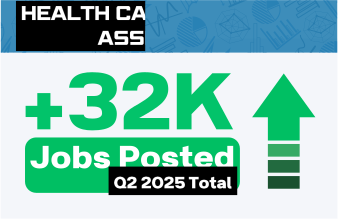
Health Care and Social Assistance
According to Geographic Solutions’ online advertised job postings, Education Services saw an increase of 28,104 positions. While this exceeds the average growth seen in previous quarters, this aligns with hiring expectations as schools list positions in Q2 and Q3 for the upcoming school year.
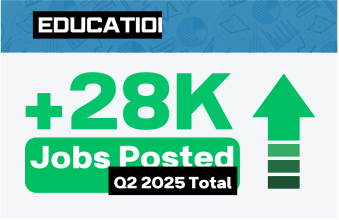
Education Services
Although job postings in this industry dropped by 32,383 compared to the previous quarter, this decrease is significantly lower than declines observed in other quarters over the past two years. Combined with June 2025 BLS employment information from CES, this continues to support the theory that employment in this industry is stabilizing.
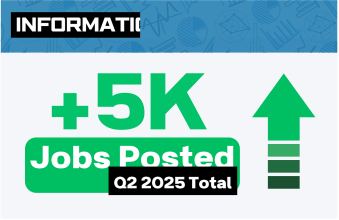
Information Technology
Geographic Solutions’ Job postings for the Information industry increased by 5,482 listings, rather than decreasing as expected. This may signal that employment growth in this industry will continue, which aligns with the BLS employment data.
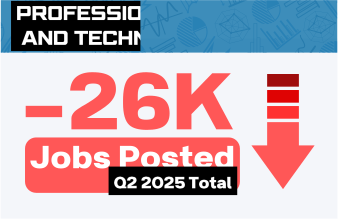
Professional, Scientific, and Technical Services
Geographic Solutions advertised job postings in this sector declined by 15,043, representing a higher-than-average loss compared to previous quarterly changes. Policy changes and uncertain funding may be impacting employer decisions to post these positions.
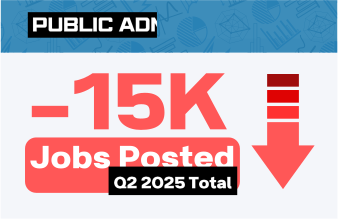
Public Administration
Geographic Solutions’ postings saw a decline of 26,256 listings. The decline in postings, combined with increased employment in the Professional and Business Services series, could indicate that companies are experiencing less turnover than in previous quarters.
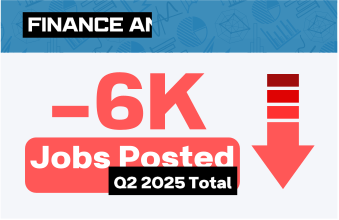
Finance and insurance
This category saw a decline of 6,342 postings, an above-average loss compared to previous quarters. Like the previous sector [Professional, Scientific, and Technical Services], the decline in listings coupled with an above average employment performance in the Financial Activities could indicate higher retention rates for companies in this sector, or budget caution in an uncertain economy.
Geographic Solutions derives its employment forecast and unemployment rate forecast from internal data on the number of job openings, searchers, and employment and unemployment applications filed on Geographic Solutions' state client sites. The forecast uses unemployment claims data from the U.S. Department of Labor (USDOL).
Meet Our Economist
-1.png "Economists Predictions")
How We Matched Up
- Geographic Solutions: Geographic Solutions' expectations of 10,000 jobs were short of the 22,000 jobs added in August. The unemployment rate expectation of 4.2% was just under the 4.3% outcome.
- The Wall Street Journal: The Wall Street Journal's expectation of 75,000 jobs being added to the labor market was significantly above what was recorded in the labor market report.
- ADP: According to ADP’s latest estimate, the private sector added 54,000 jobs in August, compared to the 38,000 reported by the BLS.
Phillip Sprehe is the Lead Economist at Geographic Solutions and corporate subsidiary company iQuery. Throughout his tenure with Geographic Solutions, he has been successful in assessing macroeconomic data and financial markets for the entire country. He has been able to accurately predict the economic impacts of the labor market by monitoring key economic indicators as well as analyzing internal and publicly available data, such as unemployment claims, United States Treasuries, equity markets, and COVID-19 metrics.
Phillip's research has been featured globally by news outlets, both in print and broadcast. Publications and networks include Business Insider, CNET, ConsumerAffairs, Le Monde, GoBankingRates, and The Daily Express US. His commentaries routinely have higher prediction proximity than large media outlets like The Wall Street Journal.
-1.png?width=1000&height=1000&name=Untitled%20design%20(7)-1.png "Untitled design (7)-1")
Contact Us
Are you enjoying our economists' insights and analysis? Interested in having them speak or provide content for podcast, television, internet, or other mediums? Please email us using this form.
Previous Monthly Reports
- June 2026 - Forecast | Analysis
- May 2026 - Forecast | Analysis
- April 2026 - Forecast | Analysis
- March 2026 - Forecast | Analysis
- February 2026 - Forecast | Analysis
- January 2026 - Forecast | Analysis
- December 2025 - Forecast | Analysis
- November 2025 - Forecast | Analysis
- October 2025 - Forecast | Analysis