
Key Takeaways
-
According to the most recent report from the Bureau of Labor Statistics (BLS), employment in the U.S. decreased by 67,000 in the fourth quarter of 2025 while the unemployment rate remained at 4.4%.
-
This decrease in jobs was largely caused by federal workers accepting buyouts in October before layoffs were set to begin.
-
Sentiments among consumers continued to slide in the fourth quarter.
Labor Market Overview
Labor Market Insights
- Even without the large drop in October employment from federal employee resignations, the job market still shows a weakening trend. Private sector employment change in the fourth quarter was 88,000. That is positive but still lighter than in the third quarter (170,000) and the second quarter (175,000).
- The U-3 unemployment rate, which indicates only the number of unemployed people actively seeking a job, has been gradually increasing over the past two years. The U-6 unemployment rate, which includes discouraged, underemployed, and unemployed workers in the country, increased by 0.3% in the fourth quarter to 8.4% after a rapid 0.4% rise in the third quarter. The labor force participation rate has been fluctuating over the past year, but ends 2025 at 62.4%, down only 0.1% from a year earlier. The stability of both the U-3 unemployment rate and the labor force participation rate over the last quarter suggests that the rise in U-6 may reflect a surge in underemployed workers who wish to work full-time hours. Average weekly hours for private-sector workers have held constant for three straight quarters.
- Looking at other labor market indicators, real private-sector income (wages * hours) increased by 0.5%, driven by an equal rise in wages. This was the highest wage increase since the second quarter of 2024. The stronger wages were enough to raise total earnings for all private-sector employees (wages * hours * employees) by 0.6% during the quarter, despite slow employment growth.
State-us Updates
- The District of Columbia had been losing an average of roughly 1,100 jobs each quarter over the previous two years. The fourth quarter saw a larger job decline (-18,400) than in any other state due to the deadline for Federal employees to accept buyouts or face layoffs under the DOGE program.
- Virginia and Maryland, also home to many federal workers, saw severe negative swings in employment, losing a combined 26,800 jobs in the period, even though they averaged a quarterly increase of 17,700 over two years. The mild slowdown in hiring over the past two quarters is due to a pullback in jobs in the Education & Health Services and public sectors, which accounted for nearly 74% of job growth in 2024.
- Outside of the DC area, Indiana’s labor market had a tough quarter, shrinking by 17,000 when its two-year average was growth of 6,000.
- Massachusetts’ employment in the fourth quarter increased by 13,500, despite usually losing about 1,100 jobs each quarter over the past two years.
Key Employment Insights
- Payroll on the decline
October’s largest payroll gains were in the Manufacturing and Professional & Business Services sectors. Transportation and Information Technology sectors saw the biggest decline. - Federal job cuts hampered employment growth in Q1
The recent job cuts to the federal workforce has negatively impacted the country's overall employment growth in Q1. Based on recent data from the BLS, these cuts will continue to have a negative ripple affect throughout the rest of the year. - 100k jobs lost due to recent natural disasters
Nearly 100,000 individuals lost their jobs in Q1 due to the recent wildfires, hurricanes, and flash flood that have impacted most of the country.
Looking Ahead in Q2
- Tariffs will continue to impact labor market
Based on preliminary data from the BLS, the ongoing tariff war could result in the loss of nearly 100,000 jobs across the US in Q2 alone. As businesses continue to struggle with prices, we could expect an increase in layoffs to compensate for the higher overhead costs.
- New legislation is expected to boost US employment
New legislation proposed by the Trump administration to abolish taxes could result in a significant boost to the U.S. labor market, potentially adding one million jobs across the country. - Cutting interest rates could lead to recession
If the Federal Reserve fails to achieve a soft landing in the coming months, economists predict it might send the country into a recession and result in the loss of thousands of jobs.
Key Labor Market Insights
- Two sectors cause a mild slowdown in hiring in Q2
The mild slowdown in hiring over the past two quarters is due to a pullback in jobs within the Education & Health Services and the public sector, which accounted for nearly 74% of job growth in 2024. - Manufacturing, Trade, Transportation Hit by Tariffs First
The Manufacturing and Trade, Transportation & Utilities sectors are expected to show the earliest effects from tariff policies. While both experienced losses in the second quarter, they do not appear to be major drivers of overall employment performance. - Private sector income dips amid economic worries
In light of the unexpectedly strong job numbers in the face of less favorable economic conditions, it is important to look elsewhere for signs of diminishing labor market conditions. Real private-sector income (wages x hours) declined by 0.1%, owing to a 0.3% reduction in work hours, marking the first decline in 5 quarters. This might indicate that the declining economic outlook is starting to impact the market, but companies could be reducing work hours as a preemptive measure before implementing layoffs.
Looking Ahead In Q3
- Economists look for clarity amid changing policies
Market watchers will be looking for signs on tariffs and interest rates for clarity on the direction of the economy. While the stop-go tariff maneuvers continue to add an extra degree of difficulty in projecting how the economy will perform over the next several months, the passage of the “One Big Beautiful Bill” extends most of the current tax rates that were set to expire this year.
- Steady job growth expected for Q3 and Q4 2025
Without knowing how these political developments will unfold, the economic data is pointing towards a similar pattern of job growth for the remainder of the year that we experienced in the second quarter. The Geographic Solutions forecast for the third quarter is 437,000 new jobs followed by 447,000 for the fourth quarter. - WSJ Economists Slightly Optimistic on US Growth
Economists in the Wall Street Journal Survey are more upbeat than after the first quarter. Their latest recession probability assessment roughly splits their January and April assessments, putting the odds of a recession within the next 12 months at 33%.
- National Employment - Quarterly
- National Employment - Monthly
- National Unemployment - Quarterly
- National Unemployment - Monthly
- Labor Force Participation Rate
- U6 & U3 Unemployment Rates
Employment FAQs
How have the federal job cuts impacted the labor market?
We will begin in this chapter by dealing with some general quantum mechanical ideas. Some of the statements will be quite precise, others only partially precise. It will be hard to tell you as we go along which is which, but by the time you have finished the rest of the book, you will understand in looking back which parts hold up and which parts were only explained roughly.
What are the implications of the tariff war from a labor perspective?
We will begin in this chapter by dealing with some general quantum mechanical ideas. Some of the statements will be quite precise, others only partially precise. It will be hard to tell you as we go along which is which, but by the time you have finished the rest of the book, you will understand in looking back which parts hold up and which parts were only explained roughly.
Will getting rid of taxes really jump start the labor market?
We will begin in this chapter by dealing with some general quantum mechanical ideas. Some of the statements will be quite precise, others only partially precise. It will be hard to tell you as we go along which is which, but by the time you have finished the rest of the book, you will understand in looking back which parts hold up and which parts were only explained roughly.
How optimistic are economists about the labor market in the coming months?
We will begin in this chapter by dealing with some general quantum mechanical ideas. Some of the statements will be quite precise, others only partially precise. It will be hard to tell you as we go along which is which, but by the time you have finished the rest of the book, you will understand in looking back which parts hold up and which parts were only explained roughly.

Key Unemployment Insights
- Steady as it goes
Throughout Q1 2025, The unemployment rate has consistently remained low at 4%, indicating a stable job market, boosting economic growth and consumer confidence. - Shifting Job Vacancy Ratios
The ratio of vacant jobs to jobless workers has decreased, indicating a shift in the labor market's dynamics. While still relatively tight, the market is becoming less intensely competitive for workers than it was previously - Changes in Voluntary Quits
The rate of voluntary quits has decreased, suggesting that workers are becoming less inclined to leave their current jobs. This could indicate increased caution among workers due to economic uncertainty, or increased job satisfaction.
Looking Ahead In Q2
- Tariffs will continue to impact labor market
While currently low, we anticipate the unemployment rate will gradually increase in Q2. However, this increase is expected to remain within a relatively narrow and historically healthy range.
- Federal Reserve Actions
If the Fed maintains or increases interest rates to combat inflation, it could lead to a slowdown in economic growth and potentially higher unemployment. Conversely, if the Fed begins to lower rates, it could stimulate growth and keep unemployment lower. - The Rise of Contract and Temporary Work
An increase in contract and temporary hiring suggests that businesses may be adopting a more flexible approach to staffing, possibly due to economic uncertainty. This also shows that the "quality" of jobs, may be changing.
Breaking it down Further
Despite mounting economic and geopolitical uncertainty, the national labor market notched another month of decent job gains and low unemployment. But there’s also potential trouble brewing beneath the surface of this report. Inflation remains stubbornly high and may yet climb higher. A rapid reversal in federal government hiring is showing signs of trickling down into state and local government hiring. And it remains uncomfortably difficult for unemployed people who want a job to quickly find one.All eyes will likely be on federal employment, which officially fell by 10,000 in February. But the total reduction in federal employment was likely even larger last month, given the timing of data collection that happened towards the beginning of last month. Federal employment (minus post office workers) added an average of 6,400 jobs per month between July 2022 and March 2024, slowing to roughly 3,000/month towards the end of last year and then falling off a cliff last month. This federal slowdown is also showing signs of trickling down into state and local government hiring. Local government employment gains have fallen from an average of 36,000 jobs added per month between December 2023 and February 2024, to 18,000 in the past three months.
Going forward, the full impacts of all the new policies, proposals, and abrupt reversals that are the hallmarks of this administration will begin to shape the official statistics — good, bad, or indifferent. The market’s ability to maintain its “business as usual” momentum will be tested and the anticipated soft economic landing continues to hang in the balance.
Unemployment FAQs
How will the recent natural disasters affect the unemployment rate?
We will begin in this chapter by dealing with some general quantum mechanical ideas. Some of the statements will be quite precise, others only partially precise. It will be hard to tell you as we go along which is which, but by the time you have finished the rest of the book, you will understand in looking back which parts hold up and which parts were only explained roughly.
What is the current unemployment duration?
We will begin in this chapter by dealing with some general quantum mechanical ideas. Some of the statements will be quite precise, others only partially precise. It will be hard to tell you as we go along which is which, but by the time you have finished the rest of the book, you will understand in looking back which parts hold up and which parts were only explained roughly.
Will the federal job cuts impact people claiming unemployment benefits?
We will begin in this chapter by dealing with some general quantum mechanical ideas. Some of the statements will be quite precise, others only partially precise. It will be hard to tell you as we go along which is which, but by the time you have finished the rest of the book, you will understand in looking back which parts hold up and which parts were only explained roughly.
How optimistic are economists about the labor market in the coming months?
We will begin in this chapter by dealing with some general quantum mechanical ideas. Some of the statements will be quite precise, others only partially precise. It will be hard to tell you as we go along which is which, but by the time you have finished the rest of the book, you will understand in looking back which parts hold up and which parts were only explained roughly.
Employment
- In Brief: October’s largest payroll losses were in the Manufacturing and Professional & Business Services sectors. Professional & Business Services fully recovered its loss in November (+3,000 over the last two months), but Manufacturing will have a longer path to regaining its jobs (-26,000 over the same period).
- The Big Picture: Private Education & Health Services and the Public sectors in November maintained the high growth we have seen over the last year and look to remain the primary job generators in the labor market heading into next year.
- Diving in: Despite mounting economic and geopolitical uncertainty, the national labor market notched another month of decent job gains and low unemployment. But there’s also potential trouble brewing beneath the surface of this report. Inflation remains stubbornly high and may yet climb higher. A rapid reversal in federal government hiring is showing signs of trickling down into state and local government hiring. And it remains uncomfortably difficult for unemployed people who want a job to quickly find one.
All eyes will likely be on federal employment, which officially fell by 10,000 in February. But the total reduction in federal employment was likely even larger last month, given the timing of data collection that happened towards the beginning of last month. Federal employment (minus post office workers) added an average of 6,400 jobs per month between July 2022 and March 2024, slowing to roughly 3,000/month towards the end of last year and then falling off a cliff last month. This federal slowdown is also showing signs of trickling down into state and local government hiring. Local government employment gains have fallen from an average of 36,000 jobs added per month between December 2023 and February 2024, to 18,000 in the past three months.
Going forward, the full impacts of all the new policies, proposals, and abrupt reversals that are the hallmarks of this administration will begin to shape the official statistics — good, bad, or indifferent. The market’s ability to maintain its “business as usual” momentum will be tested and the anticipated soft economic landing continues to hang in the balance.
Unemployment
- In Brief:
- What Does This Mean?: An increasing unemployment rate (both U-3 & U-6) with a declining labor force participation rate is a worrying combination. It indicates that some who were previously looking for work have become discouraged and stopped, but even those who have remained in the labor force are finding it more difficult to be employed. This may be another symptom of the hurricanes as those who previously declared temporary unemployment later permanently left their jobs, and some of them may not have begun searching for new jobs yet.
By the Numbers: Employment & Unemployment
.png "State-Us Update")
Key Employment Insights
- Impact of California's Wildfires
California lost 54,000 jobs in Q1 compared to its 2-year average of gaining 26,000 jobs per quarter. Much of this was likely caused by the devastating wildfires in Southern California in January that the state continues to recover from. - Federal cuts cause sharp decline in jobs in D.C.
The District of Colombia had the most dramatic job loss relative to its usual pace of job creation, declining by 2,500 instead of the typical increase of 640. This drop is largely due to cuts in the federal workforce. Similarly, Virginia and Maryland, which have a large number of federal employees, finished the quarter well below their recent average. - Employment growth in Oregon & Ohio surge
Oregon and Ohio experienced the highest job growth in Q1 and are the only two states to create more than twice the number of jobs they averaged over the past two years.
What We're Forecasting
- Tariffs will continue to impact labor market
Based on preliminary data from the BLS, the ongoing tariff war could result in the loss of nearly 100,000 jobs across the US in Q2 alone. As businesses continue to struggle with prices, we could expect an increase in layoffs to compensate for the higher overhead costs.
- New legislation is expected to boost US employment
New legislation proposed by the Trump administration to abolish taxes could result in a significant boost to the U.S. labor market, potentially adding one million jobs across the country. - Cutting interest rates could lead to recession
If the Federal Reserve fails to achieve a soft landing in the coming months, economists predict it might send the country into a recession and result in the loss of thousands of jobs.
State-us Update
- The current economic focus on tariffs usually revolves around industries, but the effects of tariffs will undoubtedly have a geographic pattern as states have different concentrations of industries. The 2nd quarter employment changes in states and regions may illustrate this more fully if the tariff policies remain in place the entire time.
.png "NEW ECON CORNER HEADERS (6)")
Key Industry Insights
- Payroll on the decline
October’s largest payroll losses were in the Manufacturing and Professional & Business Services sectors. [Example Headline & Text] - Federal cuts leads to sharp decline in jobs
The administration's initial actions to reduce the size of the federal workforce resulted in the loss of 12,000 jobs during the first quarter. [Example Headline & Text] - The Big Picture: Private Education & Health Services
and the Public sectors in Q1 2025 maintained the high growth we have seen over the last year and look to remain the primary job generators in the labor market heading into next year. [Example Headline & Text]
What We're Forecasting
- Tariffs will continue to impact labor market
The uncertainty of the current tariff landscape is expected to cause countless industries to make significant job cuts across the board. [Example Headline & Text] - New legislation is expected to boost US employment
The government sector is expected to fully recovered its loss in Q1 2025, (+3,000 over the last two months), but Manufacturing will have a longer path to regaining its jobs (-26,000 over the same period). [Example Headline & Text] - Edu. job cuts could cause a recession
The decline of Private Education & Health Services and the Public sectors in Q1 2025, cause result in a recession, according to the Wall Street Journal economists [Example Headline & Text]
Stock Up:
- Mining and Logging Sector: In the first quarter of 2025, we've seen the mining and logging sector surge, adding one billion jobs. Specifically, the oil & gas extraction (+300,000) and the coal mining (+200,000) industries saw the largest increase in job openings since the new administration took office. This is the result of the administration large investment to maximize the use of the country's domestic resources, such as coal and oil. We can expect to see a steady increase in the coming months as well. [Example Headline & Text]
- Manufacturing: The manufacturing sector (+600,000) significantly increased in Q1 2025 due to the recent rise in companies continueing to invest in manufacturing their goods in the US. The semiconductor and electronic components (+500,000) industry saw the largest increase in jobs due to the high tariffs placed on China. Wood products (+35,000) also saw a substantial rise as a result of recent research that shows wooden products are vastly superiors to metal ones. [Example Headline & Text]
- Leisure & Hospitality: Employment in Leisure & Hospitality (+70,000) increased sharply in the first quarter. Food services and drinking places (restaurants and bars) continues its run of strong hiring, making up 28,900 jobs created in Leisure & Hospitality for Q1. This is due to XYZ. [Example Headline & Text]
Stock Down:
- Government Sector: The administration's initial actions to reduce the size of the federal workforce resulted in the loss of 12,000 jobs during the first quarter. While it is uncertain whether this pace of cuts will continue in the foreseeable future, there is potential for more employees to accept buyout agreements. Additionally, the administration has suggested the possibility of closing down operations of the Department of Education that are not explicitly mandated by federal law. [Can you add in more data/detail about the job losses so it's different from Labor Market Overview Section]
- The Retail Sector: The retail sector appears to be reacting swiftly to the current tariff environment, with retail trade experiencing a 12.5% drop (approximately 80,000) in job openings during the first quarter. It is atypical for price increases resulting from supply disruptions to affect retail job openings before impacting manufacturing jobs; however, this scenario is plausible. [Can you add in more data/detail about the job losses so it's different from Labor Market Overview Section]
- Construction Sector: Similar to the retail sector, construction saw a sharp decline in job openings (-800,000) due to the current tariff environment. As the cost of materials continues to grow, we can expect construction to slow down in the U.S., which could result in the loss of even more jobs. [Example Headline & Text]
Employment By Industry
Industry Insights
- Consumer sentiment has soured due to high prices, political tension, and job insecurity, yet actual spending remains surprisingly resilient. While confidence indices hit lows in late 2025, retail and food service sales grew 3.3% annually. This disconnect highlights a public that feels financially pressured but continues to spend.
- Headline unemployment masks a troubling rise in long-term joblessness and underemployment, now at levels unseen since 2022. While healthcare and hospitality sectors are still hiring through existing networks, the trade and logistics industries are cooling rapidly. The market is transitioning into a slower, more discriminating phase defined by specific sectoral shifts.
- The Federal Reserve ended 2025 with three insurance rate cuts, bringing the target to 3.75% to support the labor market. Meanwhile, the BLS faces leadership vacancies and data reliability issues. Chronic overestimation in initial employment reports has forced significant downward revisions, leaving analysts wary of early economic signals in 2026.
Stock Up
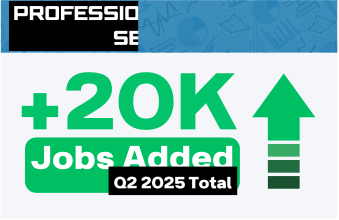
Professional & Business Services
The sector gained 20,000 employees, reversing average quarterly losses of over 31,000 employees over the past two years. Much of this addition was due to the increase in employment in Administrative & Support Services and Administration and Waste Services.
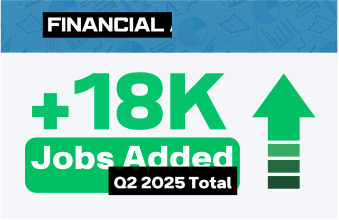
Financial Activities
Payroll employment in this sector increased by 18,000 between Q1 and Q2, marking a higher-than-anticipated growth rate in the first half of the year. Multiple subsectors contributed, notably Rental and Leasing (both Real Estate and Services) and Credit Intermediation and Related Activities.
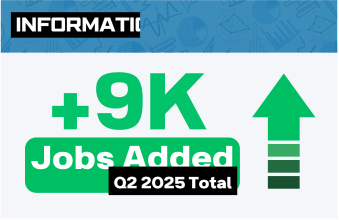
Information Technology
This sector’s employment saw a gain of 9,000 - defying an expected loss. Increases in employment in Motion Picture and Sound Recording Industries, Internet Publishing and Broadcasting, and Telecommunications industries drove the bulk of this growth.
.png?width=500&height=75&name=ECON%20CORNER%20HEADERS%20(6).png "Stock Up")
Quarterly Performance



Two-Year Quarterly Average




Quarterly Performance



Two-Year Quarterly Average



Stock Down
Stock Down

Government
The sector did see an employment increase of 105,000, but growth for the previous quarter continues to trend below average. Continued cuts in the Federal subsectors drive overall growth down, though increases in State and Local government sectors have offset a large portion of the decline.
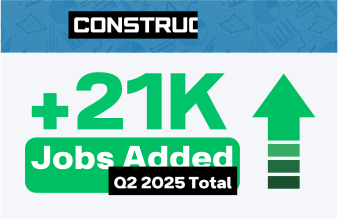
Construction
Though the sector’s payroll employment grew by 21,000, lower-than-anticipated performance in many of the major subsectors (Specialty Trade Contractors, Heavy and Civil Engineering Construction, Construction of Buildings) prevented the growth from reaching the average increase of previous quarters.
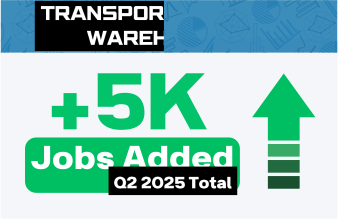
Transportation and Warehousing
Employment was still positive at a gain of 5,000 employees, but this falls well below the average quarterly gain from the past two years. This could signal responses to changes in consumer spending, driving shifts in the volume of goods being shipped or stored.
Industries on the Rise
Private Education & Health Services | +141,000
The sector gained 141,000 employees in the fourth quarter, keeping relatively short of the average gains of 170,000 employees over the past two years. Much of this addition was due to the increase in employment in Health Care & Social Assistance, with a further breakdown between Ambulatory Health Care Services and Social Assistance contributing the most to this category.
Leisure & Hospitality | +77,000
Employment in this sector increased by 77,000 in the fourth quarter, marking a slightly higher number of employees than the average two-year increase, which was 74,000. Food Services & Drinking Places contributed the most to the growth of this category.
Other Services | +14,000
This sector’s employment saw a gain of 14,000, only 3,000 lower than the average gains over the last two years. Increases in employment within Personal and Laundry Services, and Religious, Grantmaking, Civic, Professional, and Similar Organizations drove the bulk of this growth.
Industries on the Decline
Government | -155,000
The sector saw an employment decrease of 155,000 in the fourth quarter, but the average growth for the last eight quarters was 16,000. Continued cuts in the Federal subsectors drive overall growth down, though increases in Local government sectors have offset a modest portion of the decline.
Trade, Transportation & Utilities | -106,000
The sector’s payroll employment shrank by 106,000, vastly short of the average two-year increase of 3,000. This trend is most reflected in a few key subsectors such as Couriers and Messengers, Health and Personal Care Retailers, and Warehousing and Storage.
Manufacturing | -19,000
The payroll employment of the sector experienced a decrease of 19,000, contrary to the sector’s quarterly average increase over the span of two years of 25,000. The subsector driving much of the decline is Transportation Equipment Manufacturing, with a decline of 22,000.
Job Postings By Industry
Job Postings on the Rise
Leisure and Hospitality | -2,161
According to Geographic Solutions’ online advertised job postings, Leisure and Hospitality underwent a slight decrease of around 2,161 postings, which is roughly 4.7 times lower than the two-year average decrease. Overall, the industry is performing better than expected.
Other Services | -2,953
In relation to Geographic Solutions’ job posting data, this industry is performing slightly better than its historical performance. It experienced a listing count loss of around 2,953, while its historical average over the past two years was 3,634 jobs being pulled off as listings.
Government | -18,000
Geographic Solutions’ Job postings for Government decreased by 18,330 listings, performing better than other sectors apart from Leisure and Hospitality, and Other Services. The average decline or gain over the past two years was only slightly less at -16,990.
Job Postings on the Decline
Trade, Transportation & Utilities | -91,718
Geographic Solutions advertised job postings in this sector declined by 91,718, representing approximately 3.68 times the average posting count decrease over the past two years. This industry’s job vacancies declined the most compared to all other industries based on the data available.
Private Education and Health Services | -79,875
Geographic Solutions’ postings in Private Education and Health Services saw a decline of 79,875 listings. The decline in postings in the current quarter is not too far removed from the long-run average decline on a proportional basis (1.24).
Professional & Business Services | -85,277
Geographic Solutions’ postings saw a decline of 85,277 listings. Regarding historical performance, the sector over the last two years underwent an average decrease of around 9,705 postings. The ratio between the decline in the current quarter and the two-year average is 8.79.
Breaking it Down Further
Consumer moods and spending habits reveal slightly different signals. Sentiment indices from both the Conference Board and the University of Michigan declined through the fourth quarter, with December confidence levels significantly below those of late 2024, as households expressed concerns about prices, politics, and job security. However, actual spending data did not show a decline. Advance estimates indicate that retail trade and food services sales in November (the most recent data available) were about 3.3% higher than a year earlier. This creates a familiar disconnect: although consumers feel pressured, overall spending has stayed resilient so far.
This divergence between sentiment and behavior likely reflects the labor market’s shifting composition. While the headline unemployment rate has moved only gradually, the number of people unemployed 27 weeks or longer has climbed over the past year, and long-term joblessness now accounts for roughly one-quarter of all unemployment, its highest share since early 2022. Combined with the recent rise in the U-6 measure and steady average weekly hours, this points to a rise in chronic unemployment and underemployment beneath the surface of an otherwise stable jobless rate. That dynamic helps explain why confidence has weakened.
The Federal Reserve has responded to the cooler economic environment. After maintaining restrictive rates for most of the year, it implemented three quarter-point cuts in 2025—during September, October, and December—reducing the federal funds rate target to 3.75%. Policymakers describe these as modest insurance cuts rather than a shift to aggressive easing, citing inflation still above the 2% target and a moderately expanding economy. In effect, borrowing costs remain considerably higher than before the pre-pandemic era, which continues to weigh on interest-sensitive spending even as it offers some support to the labor market.
Industry data indicate a reallocation in the labor market rather than a straightforward decline. In the fourth quarter, payroll employment increased in Private Education & Health Services by 141,000 jobs and in Leisure & Hospitality by 77,000 jobs, despite online job postings in these sectors decreasing or dropping. At the same time, Trade, Transportation, and Utilities saw both payroll employment and advertised vacancies fall sharply, signaling genuine cooling rather than simple hiring-process normalization. Employers in health care, education, and many service industries appear to be drawing down earlier postings and hiring from existing connections, whereas firms in trade- and logistics-related activities are pulling back on both current employment levels and recruitment.
Analyzing the stock-up and stock-down patterns in employment and postings reveals a labor market that is tightening in specific areas. For example, sectors such as Leisure & Hospitality and Other Services show falling postings but still see slight increases in staff numbers. This suggests these sectors are normalizing after a swift post-pandemic rebound, with employers becoming more selective and reducing their reliance on continuous advertising. In contrast, industries such as Government and Trade, Transportation & Utilities, where payrolls are contracting, and postings are also down, face a more fundamental adjustment driven by policy changes, cost pressures, and evolving demand. The imbalance between still-solid consumer outlays in retail and food services and weaker confidence, alongside rising long-term unemployment and a cautiously easing Fed, supports the view that the labor market is transitioning into a slower, more discriminating phase.
The BLS enters 2026 without a permanent replacement for its previous director, who was dismissed at the beginning of August. The Current Employment Statistics Survey has been facing chronic problems with overestimating employment in its initial estimates, which require significant write-downs in subsequent months. The problem appears to stem from low response rates by employers and seasonal adjustment factors that may have been distorted by the pandemic. The appointment of a new director might give us a clue on what steps the BLS will take to improve their data collection and refining so the advanced estimates more accurately match the final revisions. More reforms could be on the table as well. Labor market watchers will be paying close attention.
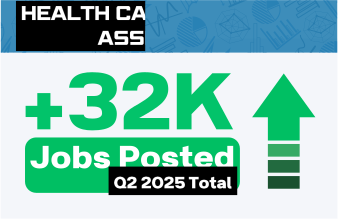
Health Care and Social Assistance
According to Geographic Solutions’ online advertised job postings, Education Services saw an increase of 28,104 positions. While this exceeds the average growth seen in previous quarters, this aligns with hiring expectations as schools list positions in Q2 and Q3 for the upcoming school year.
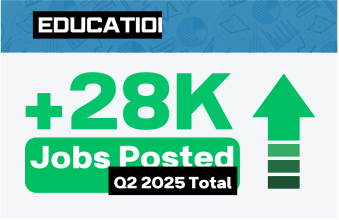
Education Services
Although job postings in this industry dropped by 32,383 compared to the previous quarter, this decrease is significantly lower than declines observed in other quarters over the past two years. Combined with June 2025 BLS employment information from CES, this continues to support the theory that employment in this industry is stabilizing.
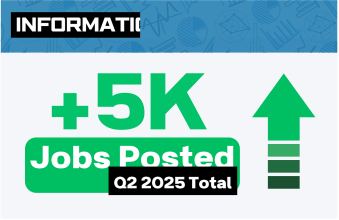
Information Technology
Geographic Solutions’ Job postings for the Information industry increased by 5,482 listings, rather than decreasing as expected. This may signal that employment growth in this industry will continue, which aligns with the BLS employment data.
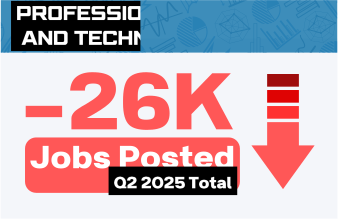
Professional, Scientific, and Technical Services
Geographic Solutions advertised job postings in this sector declined by 15,043, representing a higher-than-average loss compared to previous quarterly changes. Policy changes and uncertain funding may be impacting employer decisions to post these positions.
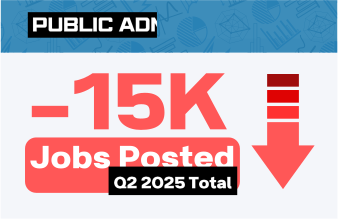
Public Administration
Geographic Solutions’ postings saw a decline of 26,256 listings. The decline in postings, combined with increased employment in the Professional and Business Services series, could indicate that companies are experiencing less turnover than in previous quarters.
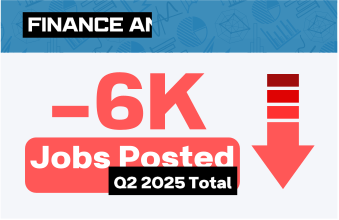
Finance and insurance
This category saw a decline of 6,342 postings, an above-average loss compared to previous quarters. Like the previous sector [Professional, Scientific, and Technical Services], the decline in listings coupled with an above average employment performance in the Financial Activities could indicate higher retention rates for companies in this sector, or budget caution in an uncertain economy.
Geographic Solutions derives its employment forecast and unemployment rate forecast from internal data on the number of job openings, searchers, and employment and unemployment applications filed on Geographic Solutions' state client sites. The forecast uses unemployment claims data from the U.S. Department of Labor (USDOL).
Meet Our Economist
Phillip Sprehe is the Lead Economist at Geographic Solutions and corporate subsidiary company iQuery. Throughout his tenure with Geographic Solutions, he has been successful in assessing macroeconomic data and financial markets for the entire country. He has been able to accurately predict the economic impacts of the labor market by monitoring key economic indicators as well as analyzing internal and publicly available data, such as unemployment claims, United States Treasuries, equity markets, and COVID-19 metrics.
Phillip's research has been featured globally by news outlets, both in print and broadcast. Publications and networks include Business Insider, CNET, ConsumerAffairs, Le Monde, GoBankingRates, and The Daily Express US. His commentaries routinely have higher prediction proximity than large media outlets like The Wall Street Journal.
-1.png?width=1000&height=1000&name=Untitled%20design%20(7)-1.png "Untitled design (7)-1")
Contact Us
Are you enjoying our economists' insights and analysis? Interested in having them speak or provide content for podcast, television, internet, or other mediums? Please email us using this form.
Previous Monthly Reports
- December 2024 - Forecast | Analysis
- November 2024 - Forecast | Analysis
- October 2024 - Forecast | Analysis
- September 2024 - Forecast | Analysis
- August 2024 - Forecast | Analysis
- July 2024 - Forecast | Analysis
- June 2024 - Forecast | Analysis
- May 2024 - Forecast | Analysis
- April 2024 - Forecast | Analysis
- March 2024 - Forecast | Analysis